Written + Edited by Lindsey Bargar, Formal Gardens Manager, + Caitlin Conner, Marketing + Communications Manager
At Daniel Stowe Conservancy, we talk a lot about nature and outdoor recreation and education and sustainability… but there’s actually an important pillar of who we are that’s often overlooked: Arts and Culture. Stowe is home to dozens of beautiful, creative and awe-inspiring pieces of art scattered throughout the property, from our iconic Disco Dog at the Village entrance to the stunning stained glass ceiling of our Garden Pavilion. Art and nature craft a curated journey across our 380 acres and each piece of art has a unique story to tell.
Next time you visit Stowe, we encourage you to slow down and go on a self-guided scavenger hunt to admire all the beautiful art across The Gardens and beyond. Use this blog post as your guide and we’ll walk through each space together, from the entrance to the Perennial Gardens, uncovering art, culture and history with every step.
Huge shout out to Formal Gardens Manager Lindsey Bargar for completing the research on each piece of art!
Stowe Entrance
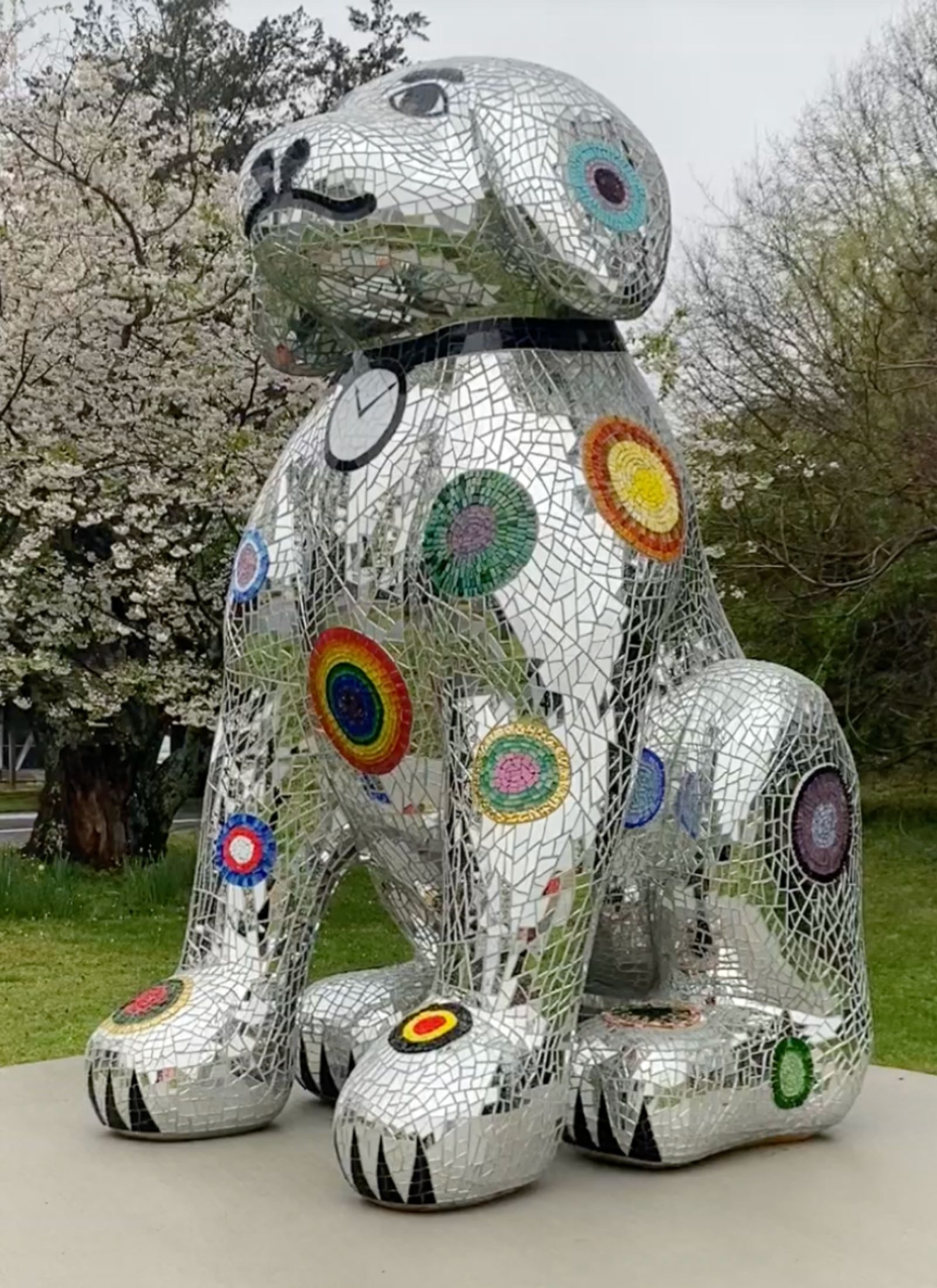
Spot the Disco Dog
Spot the Disco Dog by Elizabeth Laul Healey
Materials: Italian Smalti glass, mirrors, stones, mosaic tiles and lots of love (according to Elizabeth)
Location: Entrance to The Village at Stowe by the Dog Park
Spot the Disco Dog greets you as you enter The Village at Stowe and absolutely cannot be missed with his shiny reflective surface and gigantic puppy dog eyes.. This unforgettable piece is by Elizabeth Healey, an established artist from California, is known for her gigantic “disco” style large sculptures. This one, a watchdog known as Spot, sits at an impressive 8′ tall outside the Dog Park here at Stowe. Healey expressed with this work that ever since the pandemic in 2020, she has wanted to bring cheer and hope with her sculptures. He has become a notable feature when approaching Stowe, welcoming guests at the Village entrance with a smile.
Garden Pavilion
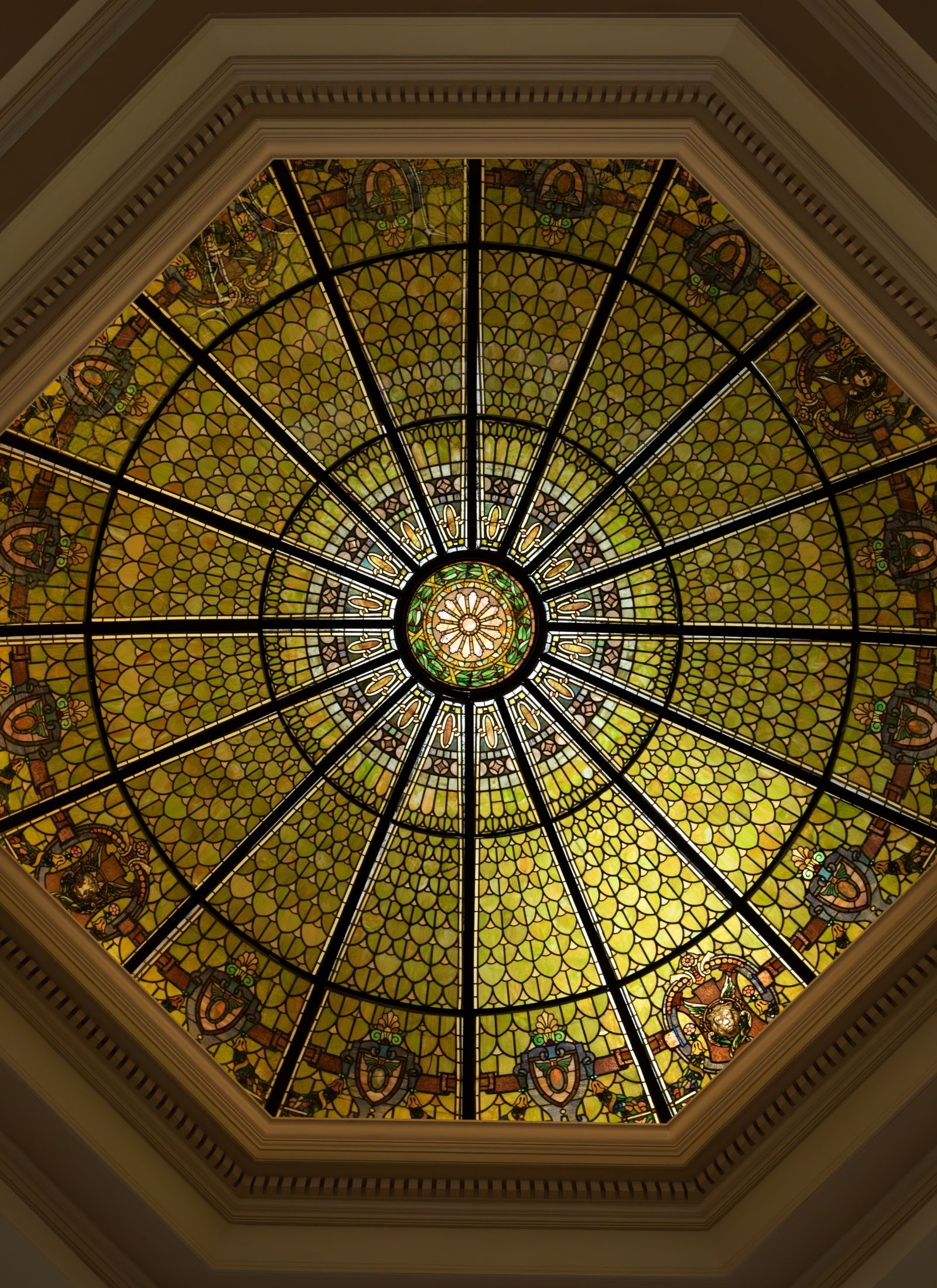
Glass Rotunda
Glass Rotunda
Materials: Stained Glass | Location: Ceiling of the Garden Pavilion
Our giant stained-glass rotunda was once part of the First Baptist Church in Canton, OH. When the church was torn down, the rotunda was saved and moved to an antique emporium in Atlanta, GA. The developers of the property found it and moved it to Belmont, NC, changing their original plans for the Garden Pavilion to make it fit. Here, it was re-constructed, piece-by-piece to create a jaw-dropping statement upon entrance to the Garden Pavilion. Look up next time you visit and find yourself mesmerized by it’s bright, botanical-inspired beauty.
Boardroom Courtyard
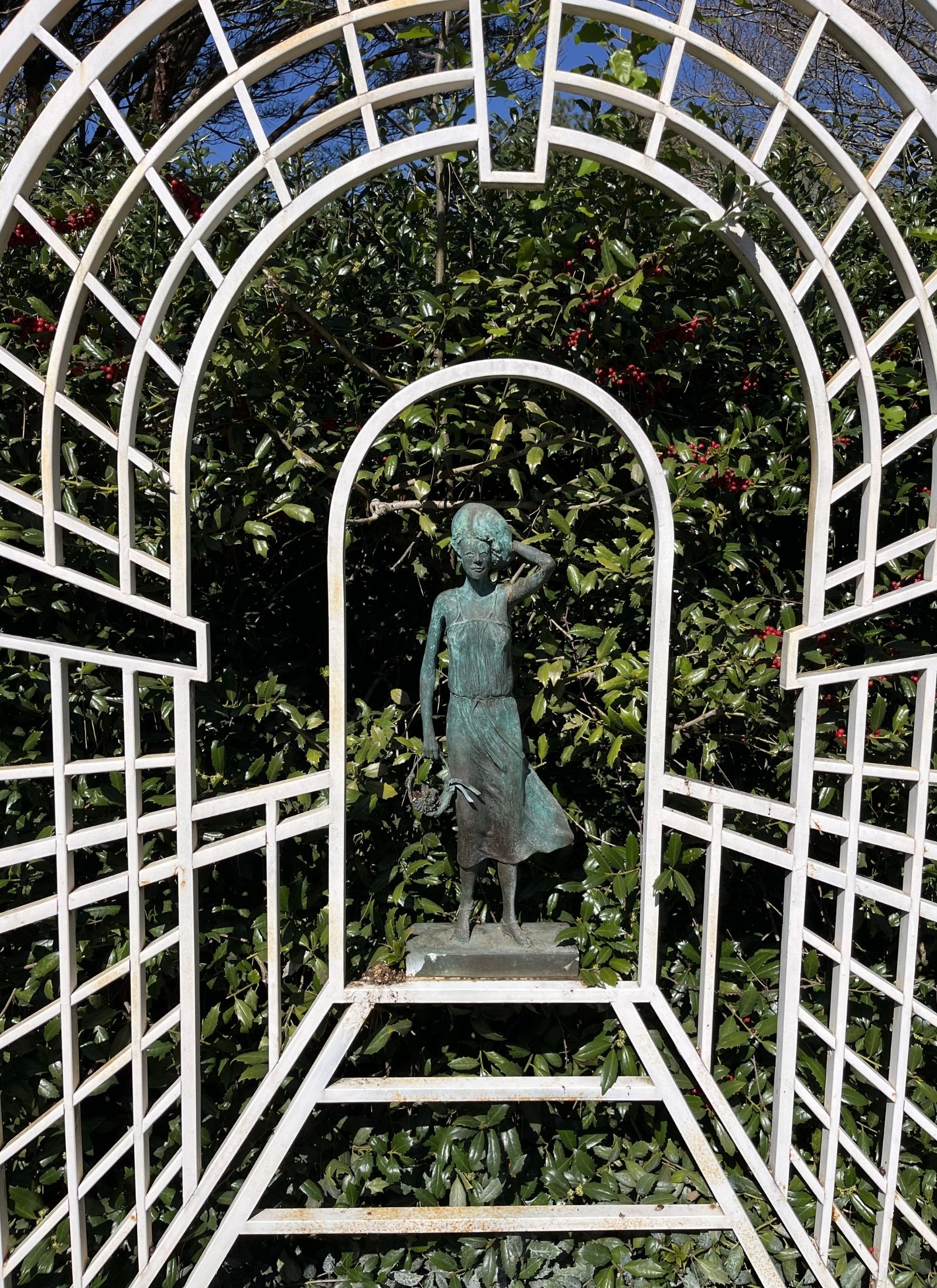
Laura
Laura by Graham Weathers
Materials: Bronze | Location: Boardroom Courtyard near the White Garden
After exiting the Garden Pavilion and entering The Gardens, you’ll turn right to find our first statue in The Gardens. Follow the corridor beyond the building until you find a small fountain with a white framing backdrop. Inside this backdrop, is Laura, a small bronze statue of a girl holding a basket. This piece was actually commissioned to local artist Graham Weathers by the Garden. Weathers was born in Stanley and originally pursued a career as a family doctor. After receiving his doctorate in 1960 and working with his father, he went on to follow his passion for art and earn a degree in sculpting from UNC in 1980. He is also famous for his life-sized bronze image of Queen Charlotte Walking Her Dogs in uptown Charlotte, located at the corner of 5th and College. Despite our best efforts, we couldn’t find out who Laura was or why The Garden commissioned her likeness. If you have any insight, please reach out to us!
Williamson Conservatory
Star by Tendai Gwaravaza
Material: Cobalt Stone | Location: Williamson Conservatory
After you find Laura near the White Garden, turn around and head back toward the Four Seasons Lawn. If you look to your left, you’ll see our large glasshouse: The Williamson Conservatory, home to all of Stowe’s tropical plants such as orchids, bromeliads, succulents and more. You’ll find several statues in the Williamson Conservatory, so we’ll head there next.
Star greets you as soon as you enter the Conservatory. This piece by Tendai Gwaravaza, a generational Zimsculpt artist. He was raised by his grandmother, a potter, and surrounded by his uncles, who carved wooden instruments. His father taught him the art of stone sculpting. Gwaravaza has been sculpting for fourteen years now, creating sculptures inspired by the sacred beliefs of the Shona people. This piece was donated to the garden in memory of Jesse Campbell by Martha and Grady Campbell.
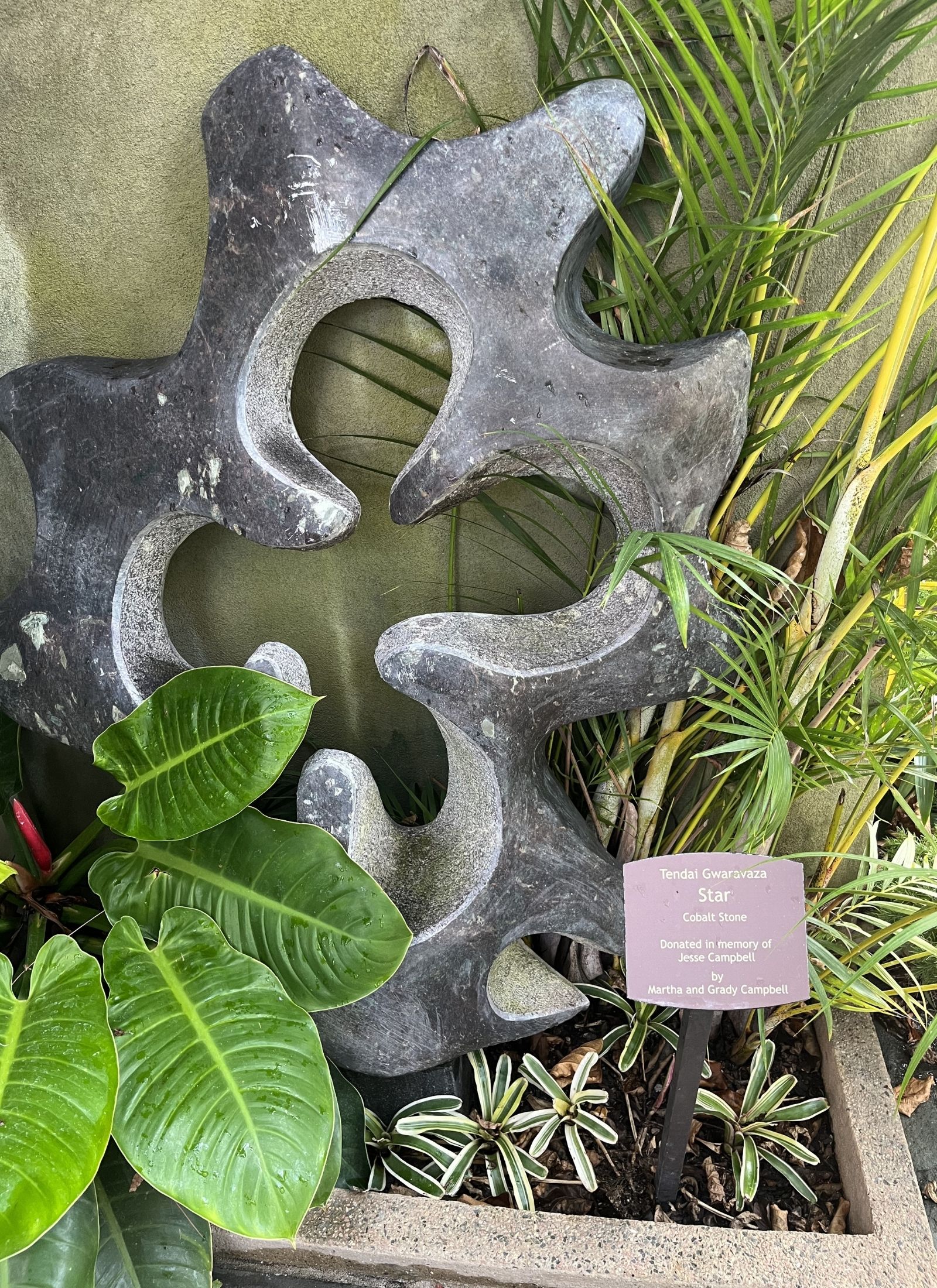
Star
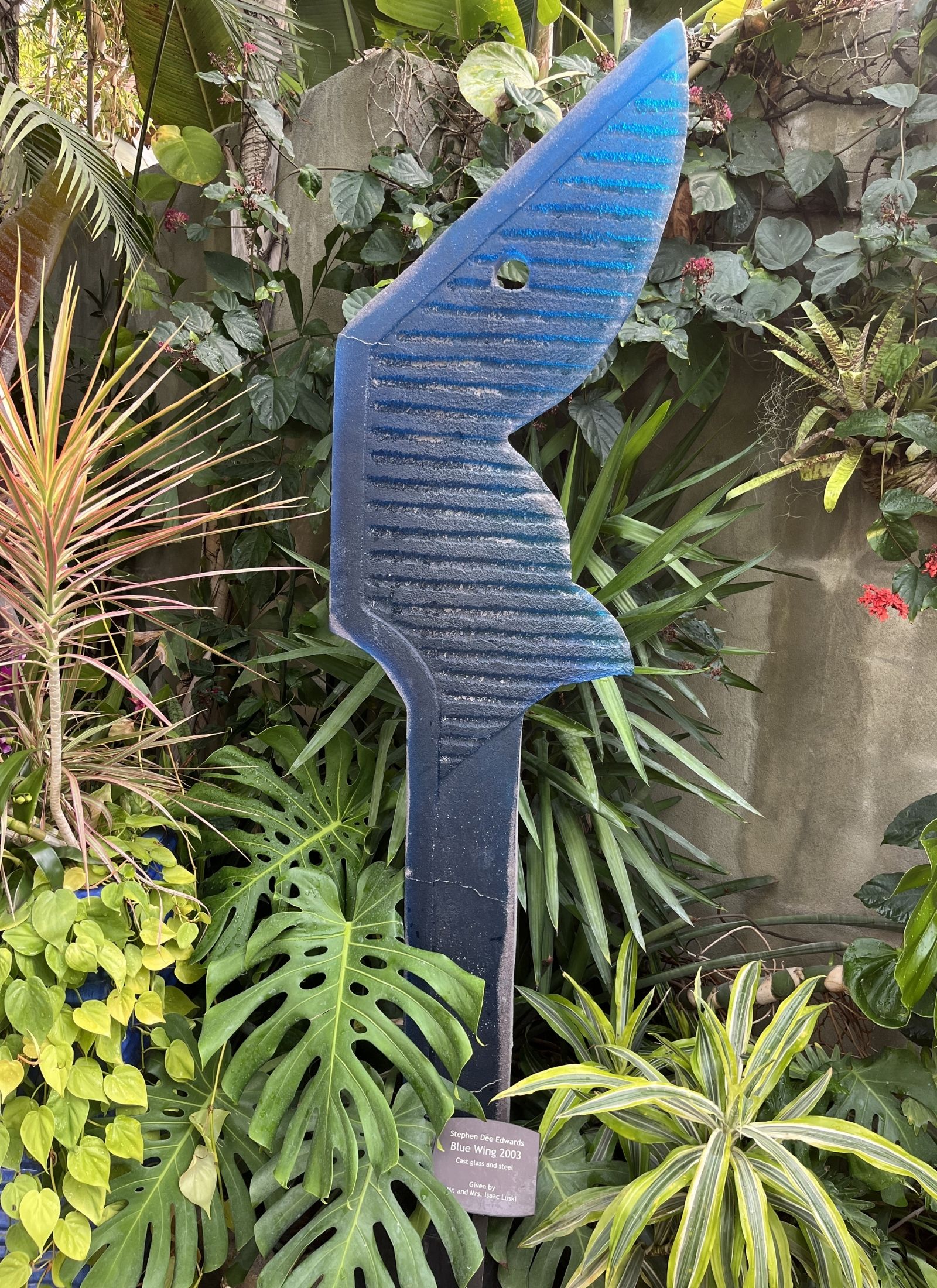
Blue Wing
Blue Wing by Stephen Dee Edwards
Material: Glass | Location: Williamson Conservatory
After you find Laura near the White Garden, turn around and head back toward the Four Seasons Lawn. If you look to your left, you’ll see our large glasshouse: The Williamson Conservatory, home to all of Stowe’s tropical plants such as orchids, bromeliads, succulents and more. You’ll find several statues in the Williamson Conservatory, so we’ll head there next.
Upon entering the Conservatory, take a right and you’ll soon spot Blue Wing by Stephen Dee Edwards, a rich cobalt statue shining in the light. Blue Wing is part of a series of statues donated by Charlotte glass collectors, Mr. And Mrs. Isaac Luski and their son Moses Luski, who also donated to and sponsored the construction of the Williamson Conservatory. Stephen Dee Edwards is one of their favorite glass artists. He was the Professor of Glass Art at Alfred University in New York. He is still actively making art, and his pieces are in museums and collections all throughout the world. The Luskis have donated his art to several other museums and businesses in the Charlotte area.
Throughout the Conservatory, you might also spot Tango, Butterfly Man and several other statues by Edwards.
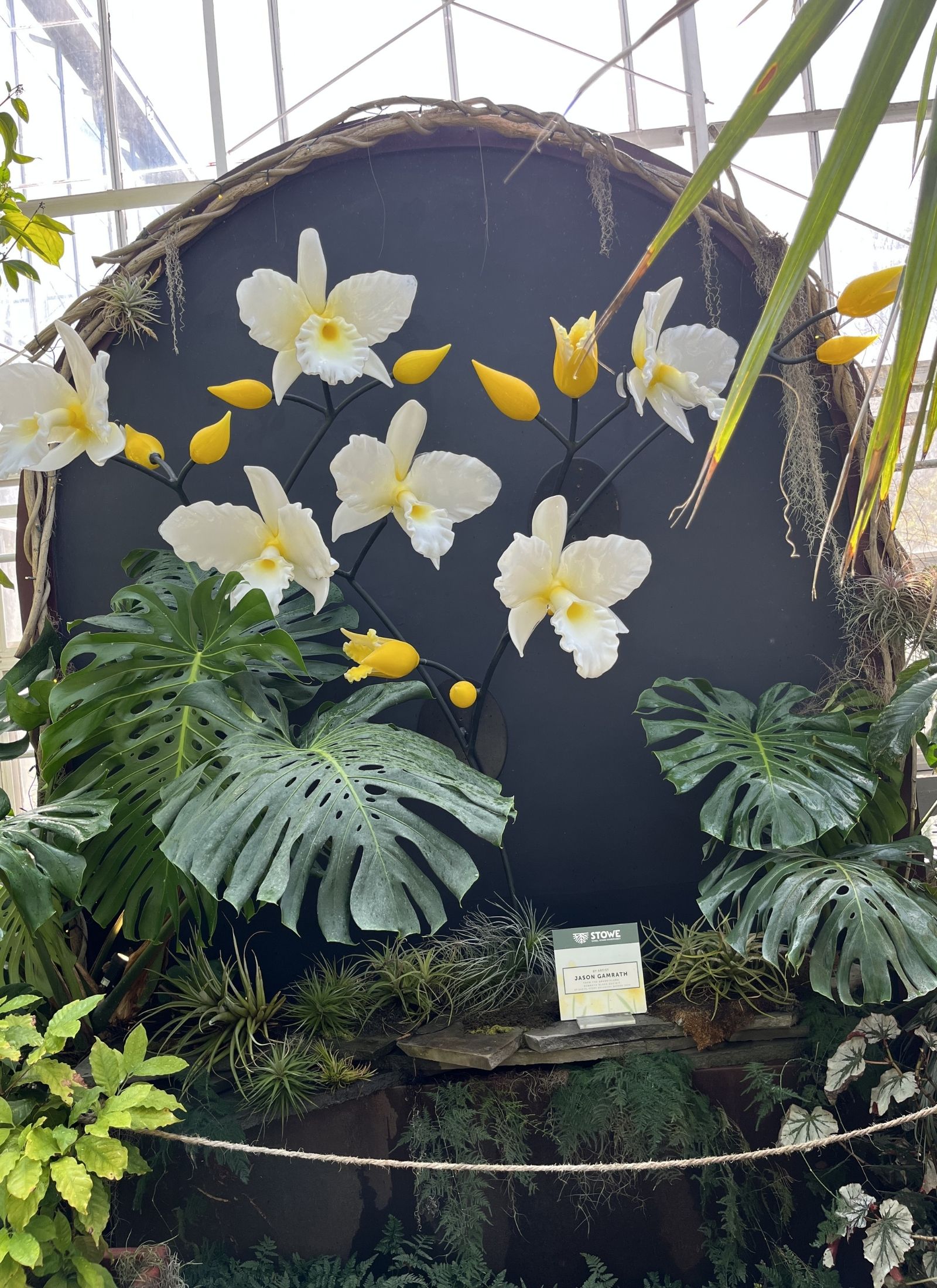
Glass Daffodils by Jason Gamrath
Material: Blown Glass | Location: Williamson Conservatory
Keep walking through the Conservatory and you’ll find yourself surrounded by several air plant archways. Just beyond these archways is the new home of Glass Daffodils by Jason Gamrath. If you’ve visited Stowe in the last few years, you may have spotted these daffodils inside the Garden Pavilion lobby, but we recently moved them to the Conservatory because that spot felt like the perfect fit for these larger-than-life flowers. Gamrath is a glass artist from Seattle, Washington that creates life size botanicals. Gamrath’s purpose with this daffodil piece was to take something small and “overwhelmingly perplexing” and capture the viewers’ interest and curiosity. While it is easy to overlook the natural beauty on a microscopic scale, Gamrath hopes that by recreating a plant on a macro scale, it lets them “observe with the same eyes through which ‘he’ humbly and graciously experiences our natural world”. Gamrath exhibited his work at Stowe in June of 2019 and this sculpture is a piece from that collection.
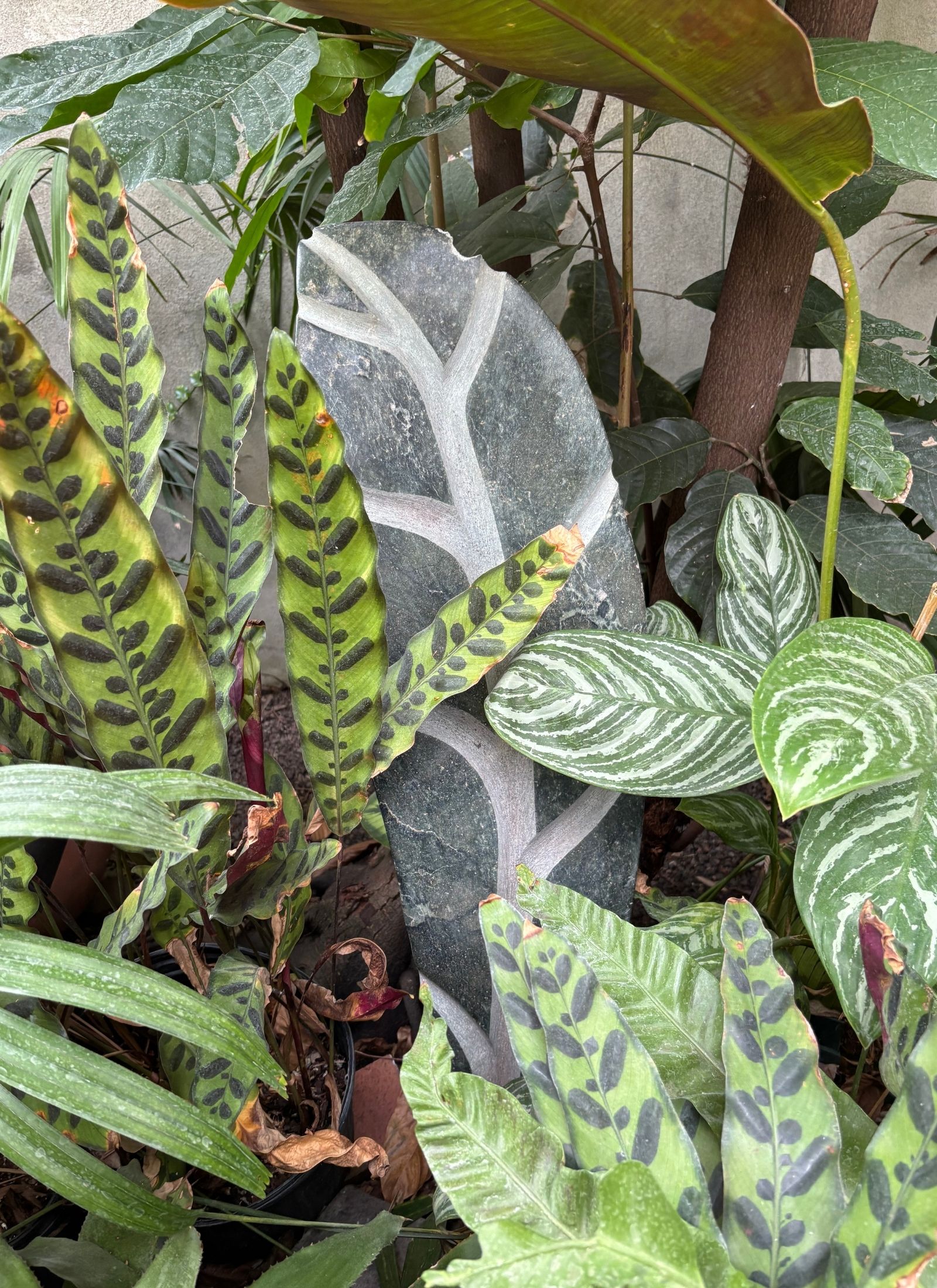
Leaf Head
Leaf Head by Patience Brunzawabaya
Material: Stone | Location: Williamson Conservatory
Blink and you might miss the final statue we’re highlighting in the Williamson Conservatory! Leaf Head is nestled into a parch of plants on the left side of the Wardian Case right before you exit the Conservatory and it’s natural color and shape camouflage it perfectly (note from Caitlin: I had to go back twice to find it because I missed it the first time!)
Discovered by Zimsculpt founder Vivienne Croisette, Patience Brunzawabaya is an up-and-coming artist. She studied at the University of Zimbabwe and now works in Chitungwiza, south of the capital Harare. This piece was part of Stowe’s Zimsculpt exhibit hosted over a decade ago in 2015.
Crape Myrtle Crossing
Child of Peace Girl (pictured) and Child of Peace Boy by Gary Lee Price
Material: Bronze | Location: Crape Myrtle Crossing
After you leave the Conservatory, head to the center of The Gardens and the next pieces of art you may stumble upon are the Children of Peace in Crape Myrtle Crossing, which is straight back beyond the Four Seasons Lawn and Cottage Garden and just before the Canal Garden. These companion pieces grace the left and right sides of Crape Myrtle Crossing, depicting a boy and girl releasing doves. These statues were donated to Stowe in 2007 by a family who lives in York, South Carolina. The pieces were believed to have originally been part of their personal garden at a different location.
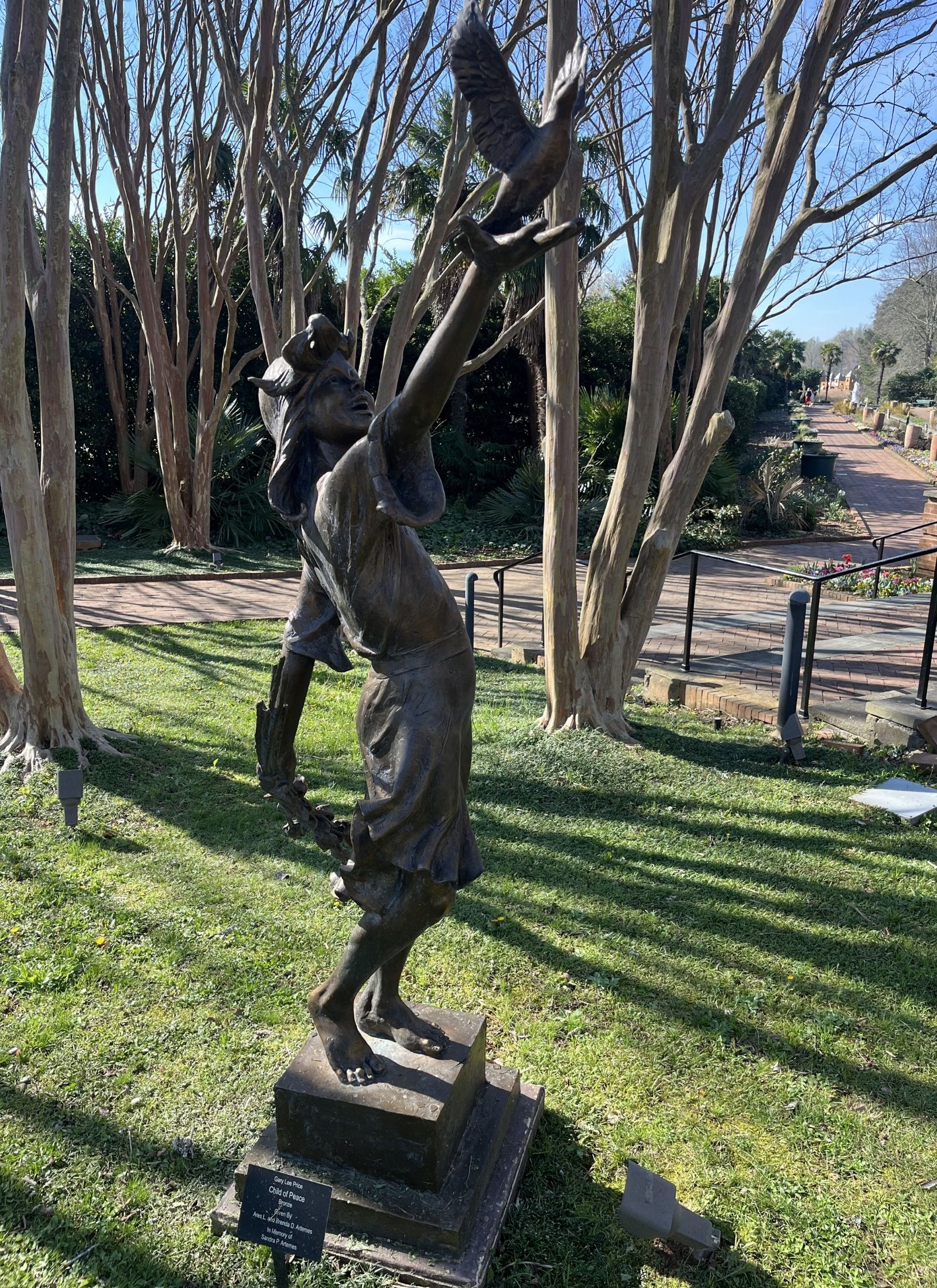
Child of Peace Girl
Canal Garden
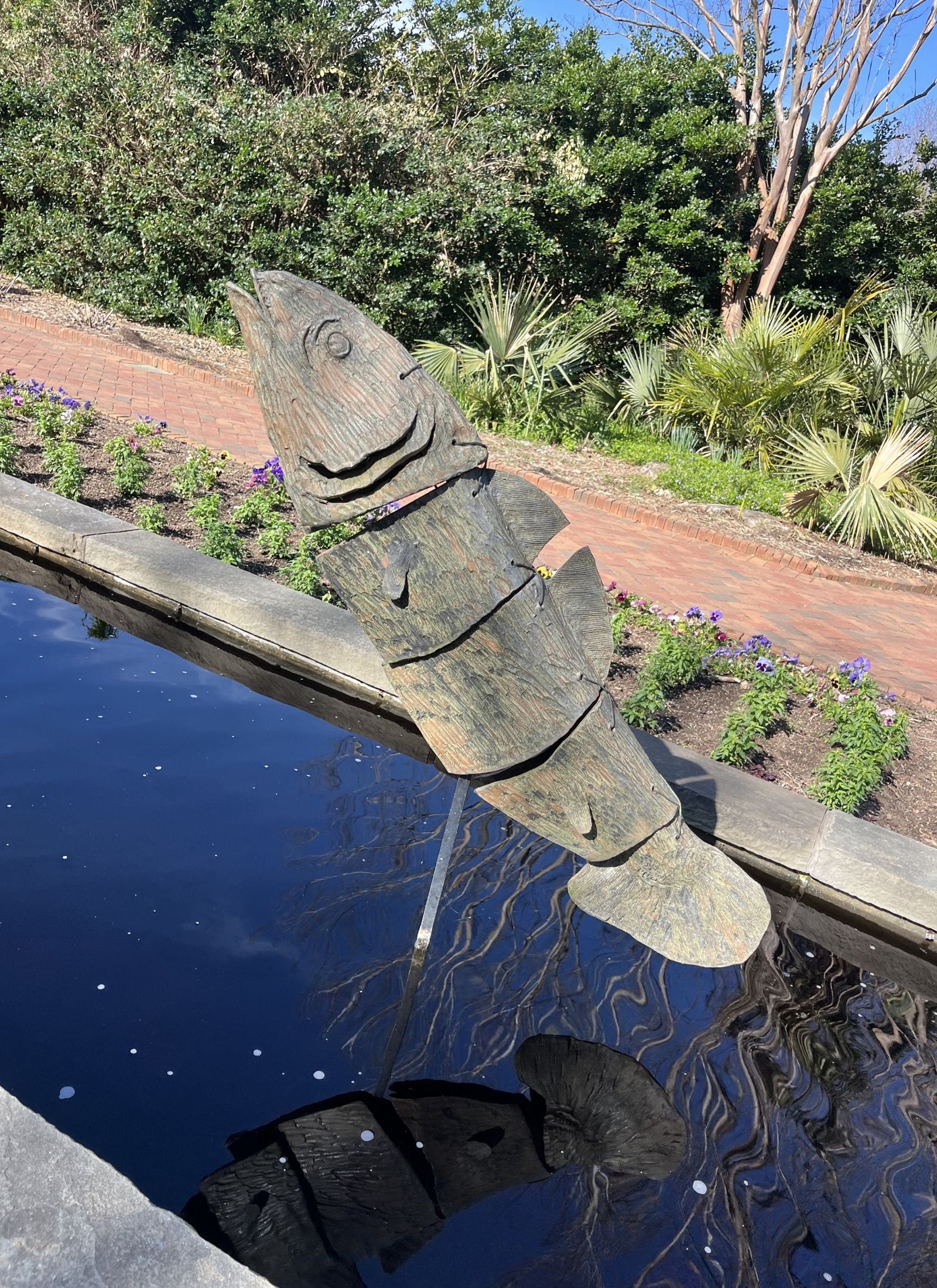
The Awakening
The Awakening by Wanda A. Hall
Material: High-fire stoneware clay, coated with a wood ash glaze | Location: Canal Garden Fountain
Just beyond Crape Myrtle Crossing, you’ll find the iconic Canal Garden, which is the focal point of many Garden photoshoots. If you’ve visited Stowe in the past, you’ve probably noticed the 10 fish sculptures leaping playfully down the length of the Canal Garden Fountain. They were originally installed as a temporary exhibit for the Canal Garden back in 2000. Garden visitors and board members liked them so much that they were purchased to be a permanent addition to the Garden.
Each fish weighs 100 lbs. (with 10 fish that is 1,000 lbs.!) and is attached to a steel armature with copper wiring. The wood ash glaze gives them a fossilized appearance. They also point toward Lake Wylie, a nod to our property’s lakefront shores.
Feathers Lillies and Raindrops by Graham Weathers
Material: Stainless Steel | Location: Canal Garden
You won’t have to go far past the fish to find the next sculpture on our list. Just beyond the fountain at the very end of the Canal Garden, you’ll discover Feathers Lillies and Raindrops, a sculpture of a large, stainless steel bird with abstract nature elements in front of it. A very different look and material than his piece Laura near the White Garden, this piece showcases Weathers in a whole new light. Weathers was better known for his work in bronze, but this shows his ability to explore different mediums and still be successful. Weathers has won multiple awards and his works are featured in numerous public and private collections. He even has a casting on board the USS Charlotte nuclear submarine and in the Mirow Castle in Germany.
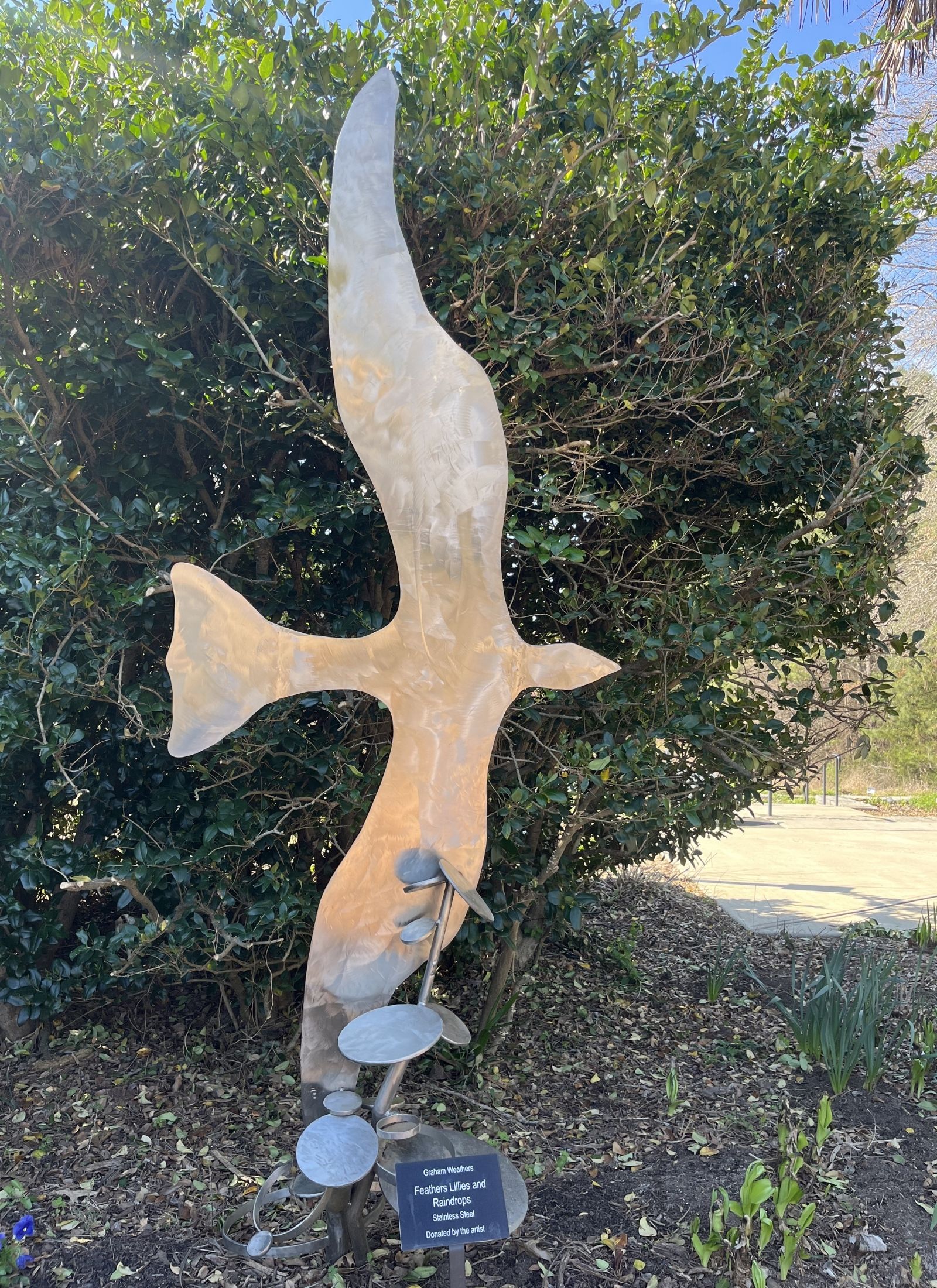
Feathers Lillies and Raindrops
Perennial Gardens
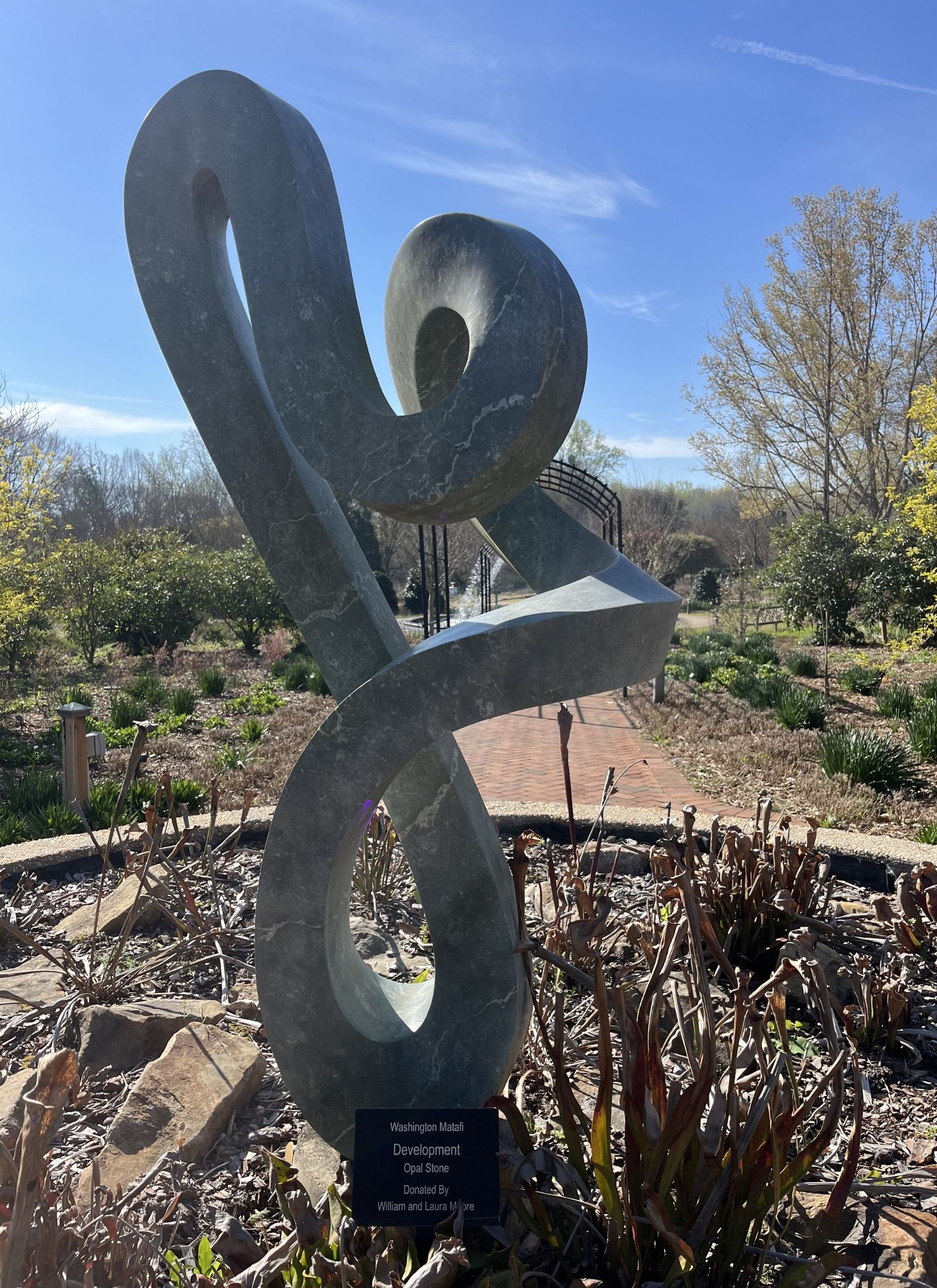
Development
Development by Washington Matafi
Material: Opal Stone | Location: Bog Garden
Once you reach the end of Canal Garden, you’ll find art both to your left in the Bog and Pollinator Gardens and to your right in Lost Hollow. Let’s start by taking a left through the Perennial Garden pergola. Once you pass through the pergola, you’ll be greeted by Development, an abstract stone shape rising out of our Bog Garden that’s home to Stowe’s carnivorous pitcher plants.
From our Zimsculpt exhibit in 2015, Washington Matafi is a prolific artist from Wedza, Zimbabwe. His art career started in 2000 when he began an apprenticeship with his close cousin Elvis Mamvura. Matafi’s more recent pieces explore the three-sided abstract, with all kinds of twists and turns, which he uses to express his message of hopes to unite people from all walks of life. He works primarily in opal stone and spring stone; common stones found in Zimbabwe. He has shown work internationally and continues to make art today.
Mother and Son by Joe Mutasa
Material: Springstone | Location: Pollinator Garden
Walk past the Bog Garden and through (or around) the Tunnel Fountain, and you’ll reach our Pollinator Garden. Close to the entrance of the Pollinator Garden, you’ll find Mother and Son.
The artist, Joe Mutasa, was born in a small-town northeast of Zimbabwe. Art was always his favorite subject, and although he went to college to study Public Relations, he ended up dropping out to become a sculptor full time.
Mutasa and his brother Gregory began a company called African Art Promotions, carving Verdite busts of animals, fine art in Zimbabwe. The incredibly hard, brilliant green stone unique to Zimbabwe, would be used to form most of Joe’s subject matter for the next four years. The skill required to work in Verdite is not to be underestimated. His sound technical background is obvious in his work today; he has the ability to dominate most kinds of stone and is considered a master of his media.
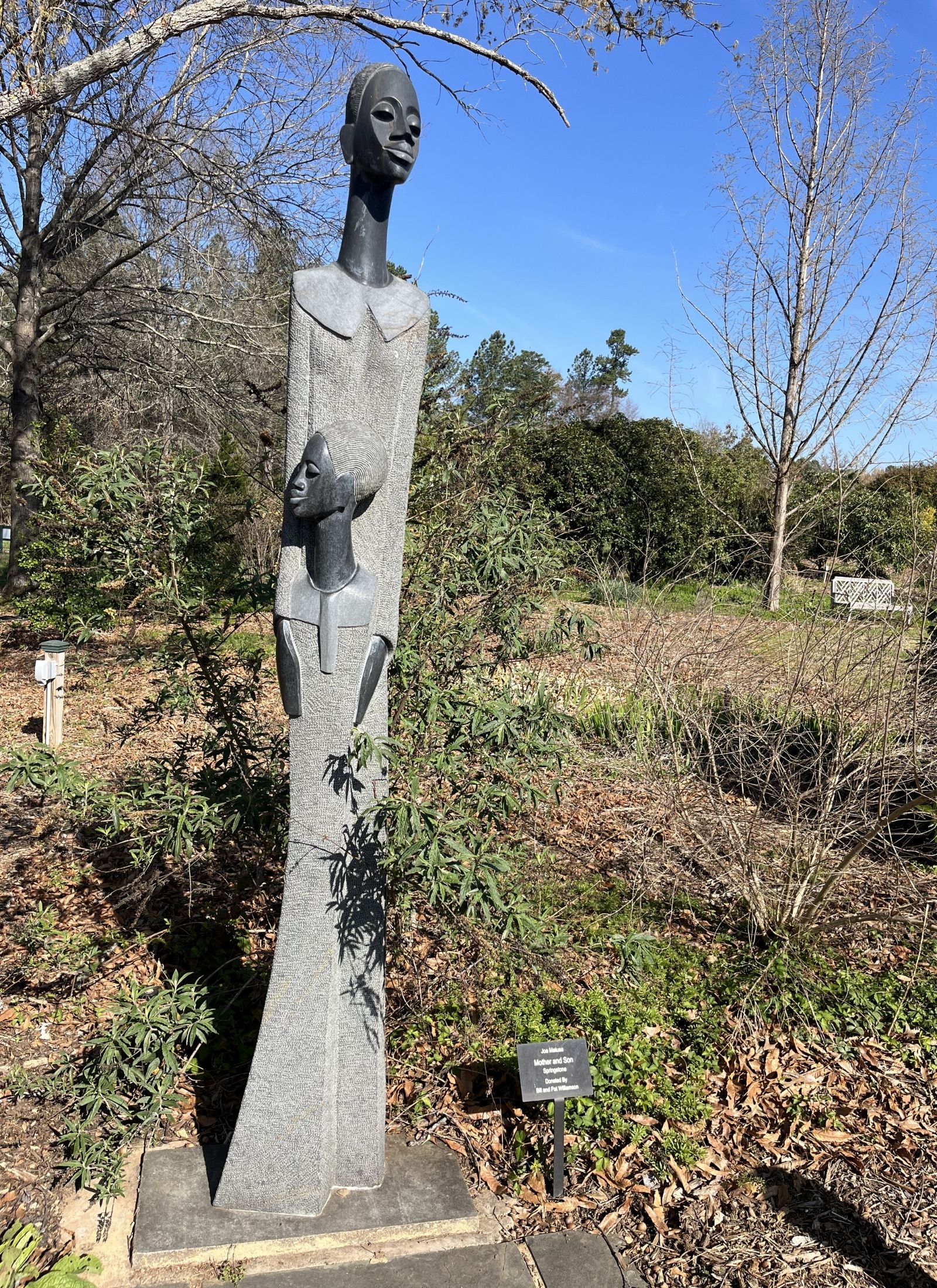
Mother and Son
However, Mutasa became bored with realism and increasingly more interested in the portrayal of emotion within, which is apparent in his piece, Mother and Son. His desire to express what he felt caused him to stop working in Verdite and search for something new and more malleable. Never revising anything he has done before, each new work from him is a surprise. The long, elegant forms stretch almost into infinity and speak tenderly of the love inherent in a close family relationship. This subject of family relationships plays an important part in Mutasa’s work, especially its role in how Shona society is changing.
This beautiful work of art was a gift to the garden from Bill and Susan Williamson.
Lost Hollow
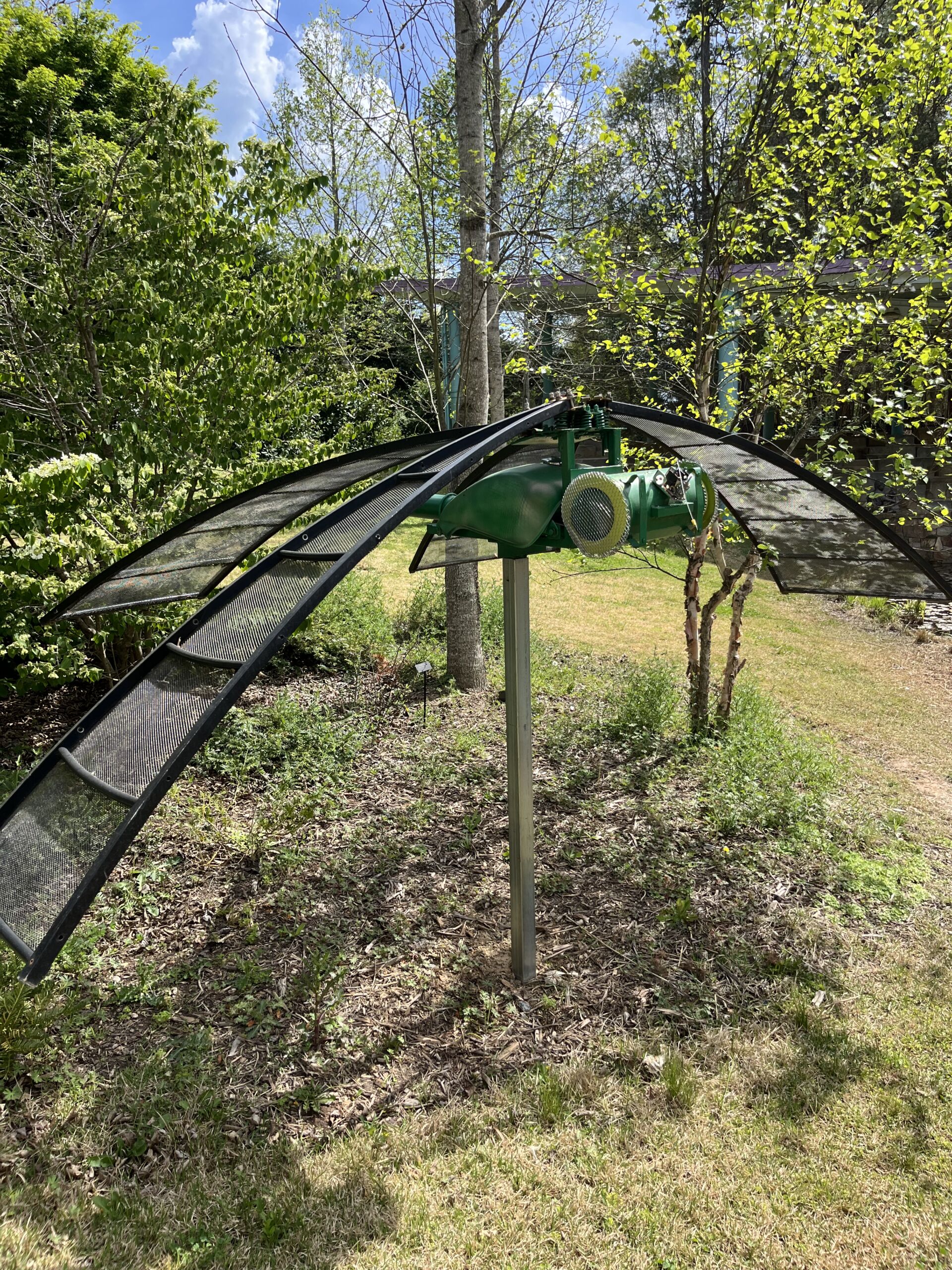
Dragonfly II
Dragonfly II by Dr. David Demperio
Material: Reclaimed scrap metal | Location: Lost Hollow
Dragonfly II is a sculptural work constructed from reclaimed scrap metal. Its body is formed from a motorcycle gas tank, the head from an air tank, and the eyes from salvaged trim rings of eyeball lights. The tail is made from a car spring, and the wings are cut from sections of an early satellite dish. This piece follows Dragonfly I, which shared a similar design but ultimately deteriorated due to structural weaknesses. In Dragonfly II, those flaws have been resolved, resulting in a more durable form intended to better withstand the elements.
Across cultures, the dragonfly symbolizes transformation, adaptability, joy, and maturity. Moving from water to air, it represents change, self-realization, and a connection to something beyond the physical world. It is often seen as a messenger of strength and good fortune.
David Demperio is the second of five children raised in a deeply creative household. His father, Thomas R. Demperio, a lifelong artist, worked as a commercial illustrator before later focusing on watercolor painting. Surrounded by art from an early age, Demperio developed a strong appreciation for creative expression. After a 43-year career as a chiropractor, he now devotes his time to artistic pursuits including sculpture, jewelry making, pottery, watercolor, and music—particularly guitar and mandolin. His work reflects both an inherited artistic sensibility and a resourceful approach to materials, transforming discarded objects into meaningful, enduring forms. Current projects include a grasshopper sculpture, which is expected to be exhibited at Stowe Conservancy in the near future.
Boy and Dog by Paul C. Nixon
Material: Bronze | Location: Lost Hollow
On the other side of the pond tucked on a ledge in the Sunken Pond Amphitheater is The Boy and Dog statue. This statue holds strong sentimental significance to The Gardens’ history, as it depicts Robert Ragan, one of Stowe’s board members, biggest supporters and benefactors (The Ragan Canal Garden is named after him!) with his childhood dog, Snip, a Fox Terrier. The statue is dedicated to Snip’s memory, since he saved Robert’s life when he was just 18 months old!
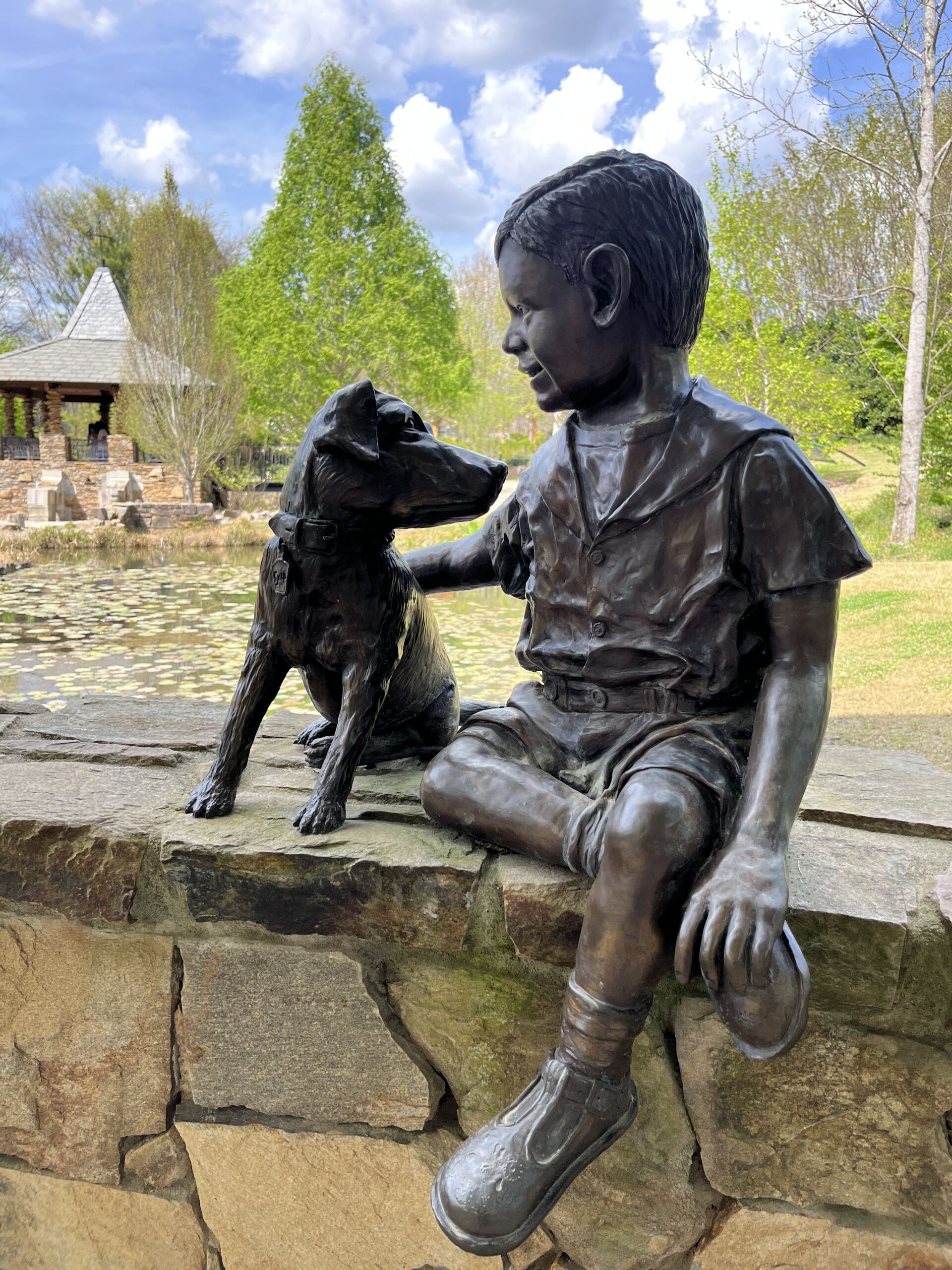
A Boy and His Dog
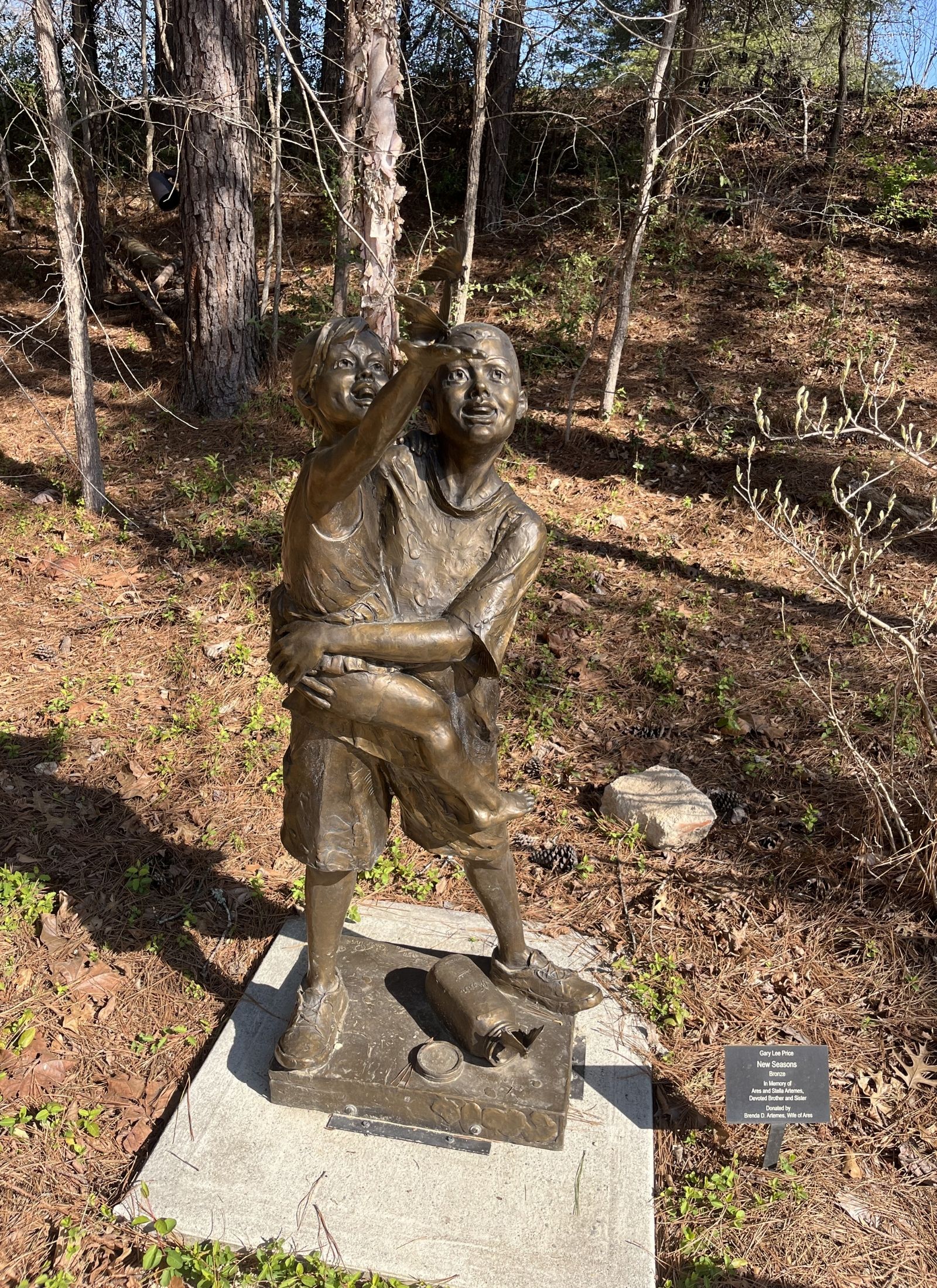
New Seasons
New Seasons by Gary Lee Price
Material: Bronze | Location: Lost Hollow
You might have to hunt a little bit for the final Lost Hollow art piece. New Seasons is located down the steps deep within the Lost Hollow garden along the right side path. This sweet statue is all about renewal, rebirth and the metamorphosis of change, depicting a boy holding his younger sister as they gaze up in wonder at butterflies she releases from her hand. Price shows a special kind of tenderness and care between the siblings, while also showing a child’s natural inquisitiveness, making this statue the perfect addition to our children’s garden. Fun fact: the boy was modeled by the artist’s own son!
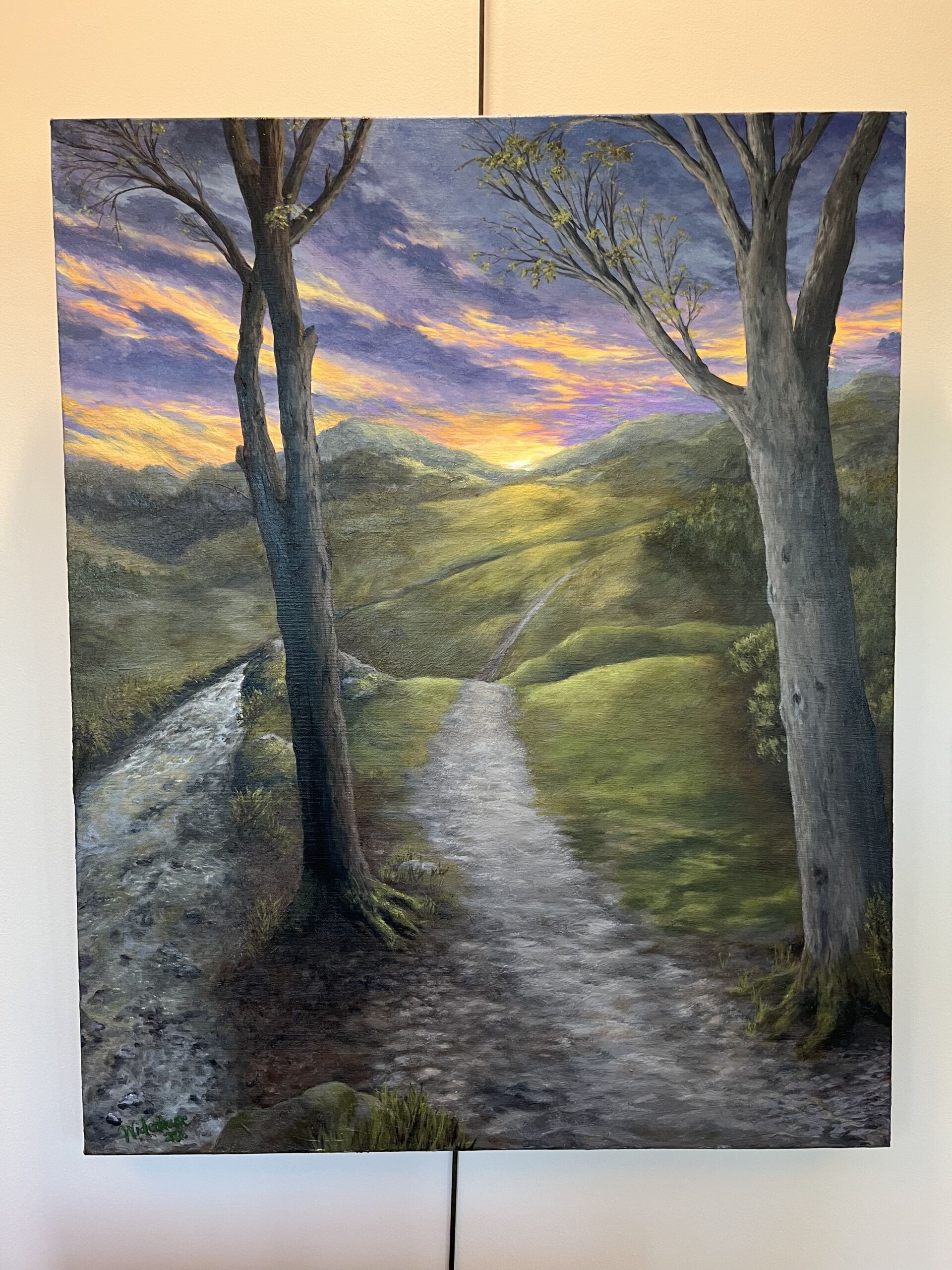
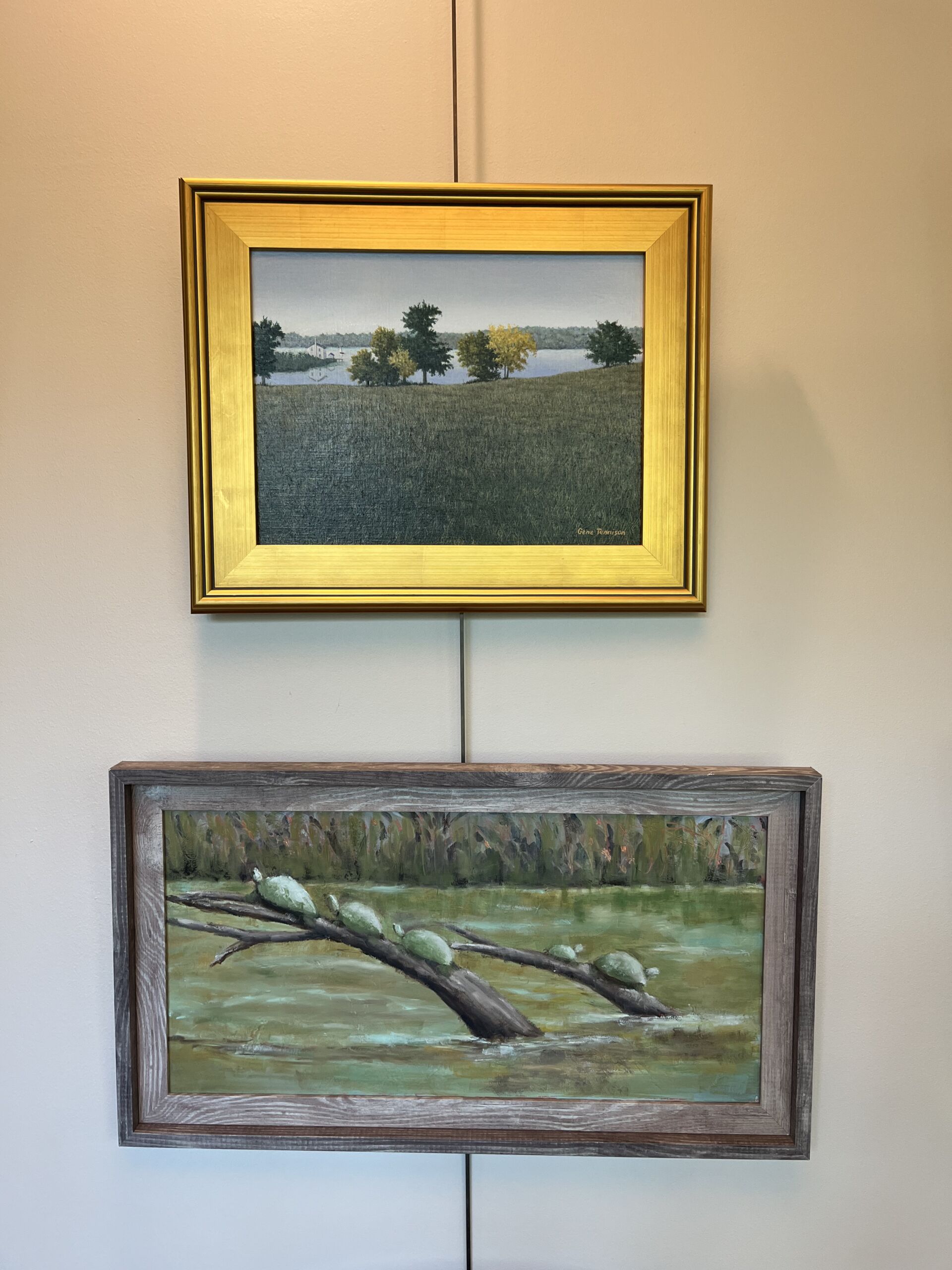
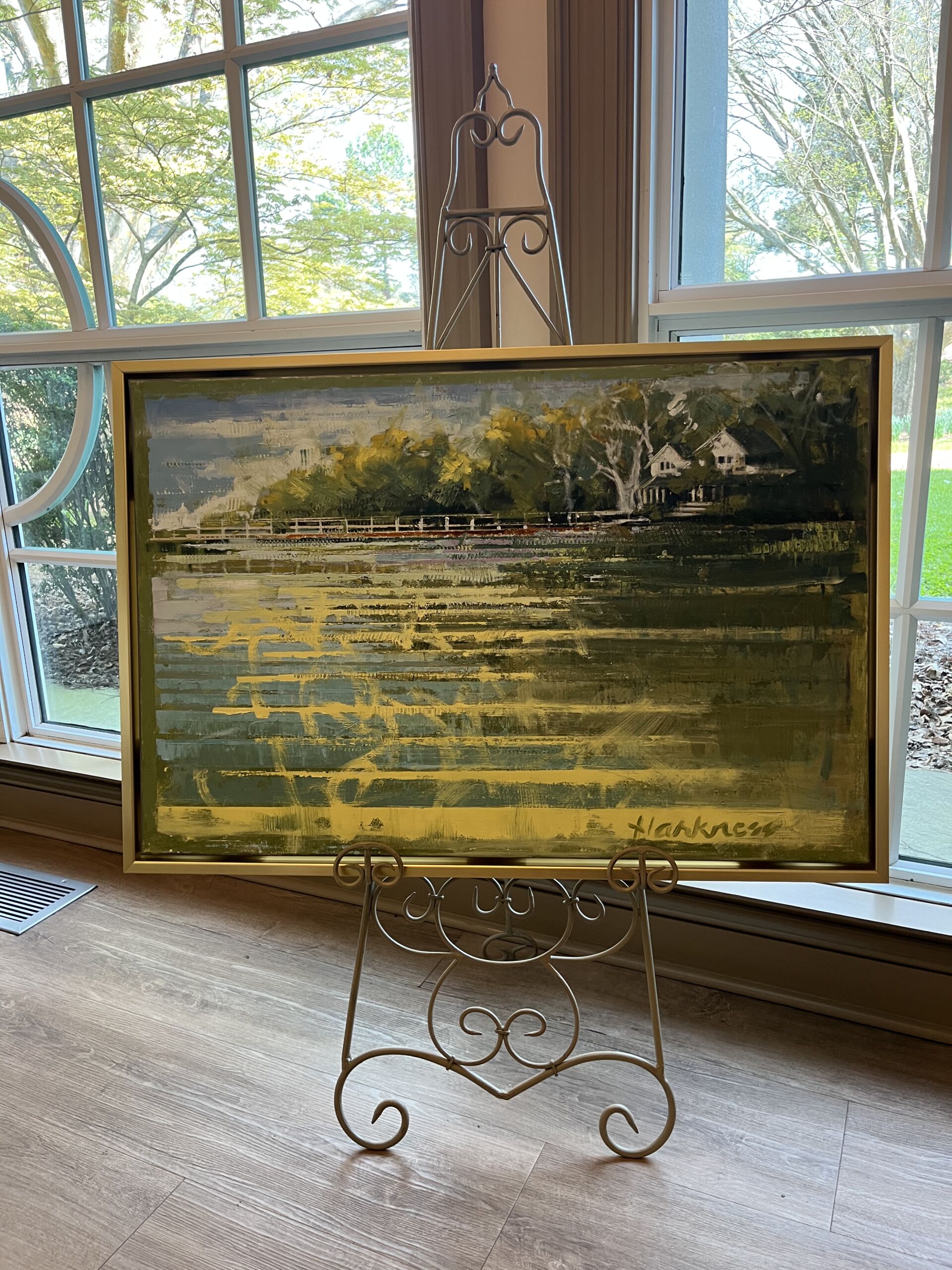
For even more amazing art, be sure to walk down the side hallways of the Garden Pavilion – we’re hosting A Natural View Art Show from the Gaston County Art Guid for the next month! Check out these nature-inspired pieces of art and stay tuned – we’ll be taking a deeper dive into the winning pieces on the blog and social media over the next few weeks. They will also be available for purchase!
This unique and diverse collection of art at Stowe highlights just how many ways there are to connect to nature here. There’s something so breathtaking about inspired by and surrounded by the beauty of nature, so we hope you’ll take the time to add an art walk to your next visit!